Mercedes-Benz Launches PLM.AI to Cut Vehicle Development Time by Up to 30%
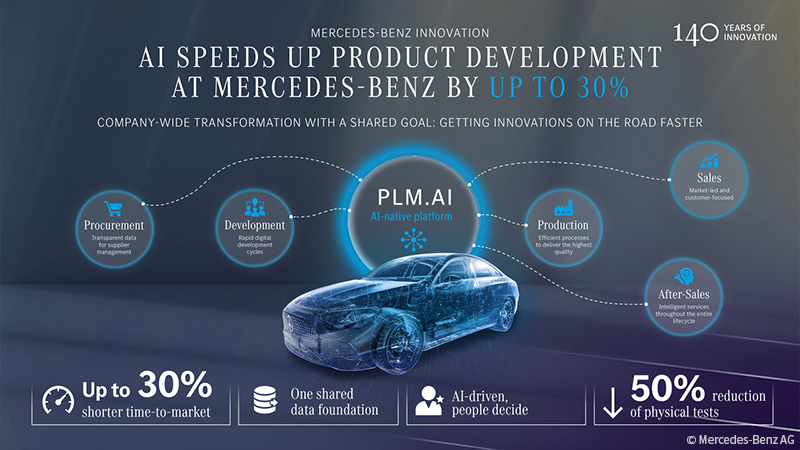
Bengaluru, India, October 17, 2026: Mercedes-Benz is introducing an artificial intelligence-powered Product Lifecycle Management (PLM) system called PLM.AI, designed to accelerate vehicle development, improve engineering efficiency and connect operations across the entire product lifecycle. The new digital platform aims to reduce vehicle development time by up to 30%, helping the German luxury carmaker bring new technologies and products to production faster without compromising its quality and safety standards.
The transformation involves an investment of around €500 million and brings together vehicle development, procurement, production, sales and after-sales on a connected digital platform. Mercedes-Benz expects to reduce development time by approximately 17 months, while individual engineering processes could see efficiency gains of up to 50%.
According to the company, PLM.AI will serve as an AI-native digital backbone, allowing teams across different functions to access relevant information, analyse complex relationships and make better-informed decisions earlier in the development process.
Jörg Burzer, Member of the Board of Management of Mercedes-Benz Group AG and Chief Technology Officer for Development and Procurement, said the platform would create the digital foundation for bringing new technologies to production up to 30% faster. He added that the system would improve connectivity across vehicle development, manufacturing and customer experience while maintaining the company’s existing quality and safety standards.
Mercedes-Benz Integrates AI Across Vehicle Development
Artificial intelligence is already being used at Mercedes-Benz for tasks such as material cost optimisation, certification and homologation, fault detection and resolution, and software development. However, these applications have largely operated within individual process steps.
PLM.AI aims to extend AI capabilities across the entire development process through standardised data models and integrated engineering information. The platform will establish a continuous digital thread, allowing information to move more seamlessly between departments and applications.
This integrated approach is expected to help engineering teams assess complex dependencies, identify potential issues earlier and bring innovations to production more efficiently.
For example, reducing the weight of a vehicle component can influence several other areas, including manufacturing costs, crash performance, hardware and software functions, and production processes. AI agents operating through PLM.AI will be able to analyse these interconnected factors simultaneously, giving engineers a broader understanding of the potential consequences of design changes.
The system will support decision-making by presenting relevant information and highlighting trade-offs, while responsibility for engineering and product decisions will remain with human teams.
AI Simulations Could Reduce Physical Testing
Mercedes-Benz also expects PLM.AI to improve the efficiency of vehicle validation. AI-powered simulations and connected development processes could enable more targeted physical testing, with the company indicating that physical tests could potentially be reduced by half over time.
A greater reliance on integrated digital engineering and simulation could help identify issues earlier, improve resource utilisation and accelerate the validation of new technologies.
The platform is also expected to create opportunities in after-sales operations by connecting product information with service and vehicle operating data. This could help Mercedes-Benz develop a more comprehensive understanding of how its vehicles perform throughout their lifecycle.
CONTACT Software and Siemens Join Mercedes-Benz PLM.AI Programme
Mercedes-Benz is working with CONTACT Software and Siemens to develop and implement the new digital engineering ecosystem.
CONTACT Software will provide the open core platform through its CONTACT Elements solution. The system offers a modular and scalable foundation for integrating product data, processes and applications, while allowing Mercedes-Benz to incorporate additional AI technologies as they evolve.
Siemens will contribute its expertise in AI-enabled automotive design, simulation and digital validation. Its solutions will support the development of digital twins and connect engineering disciplines through the shared data and process framework.
Mercedes-Benz will lead the transformation programme, defining the system architecture, data models, governance framework and overall implementation strategy. The company will also oversee the global rollout and continued development of the platform.
Mercedes-Benz Retains Control of Data and AI Models
Despite working with external technology partners, Mercedes-Benz will retain full ownership and control of its data, along with the AI models developed and used on the basis of that data.
PLM.AI is intended to become a central part of the company’s engineering ecosystem, supporting integrated, data-driven and AI-assisted development across its vehicle programmes.
The initiative reflects Mercedes-Benz’s broader push to use artificial intelligence and digital engineering to improve development efficiency and shorten the time required to bring new technologies to customers. The company maintains that these gains will come from better-connected information and earlier decision-making rather than compromises in engineering, craftsmanship, quality or safety.
Share this content:









Post Comment