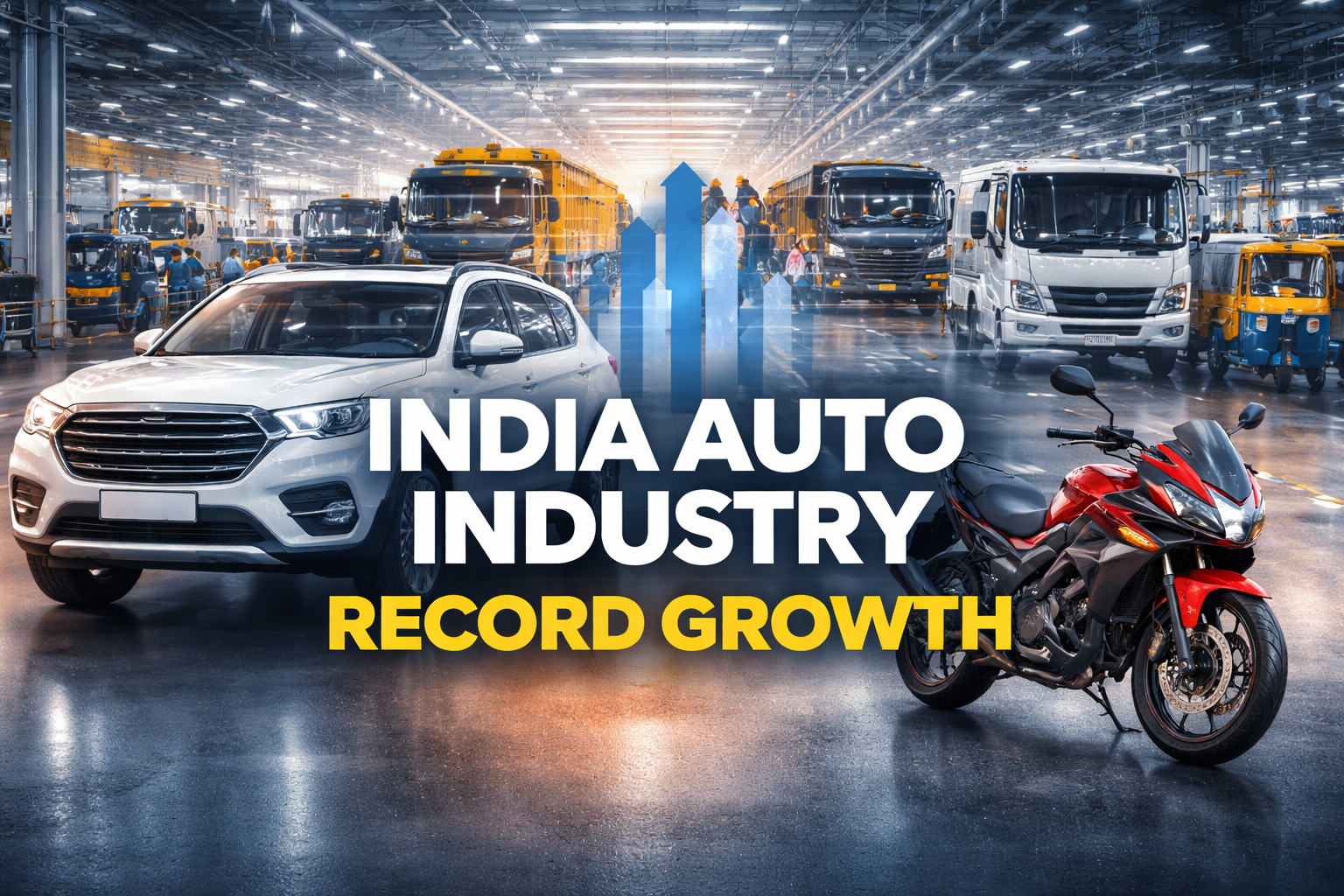
India Auto Industry Hits Record High in FY2025-26; Strong Growth Across All Segments: SIAM
New Delhi, April 14, 2026: The Indian automobile industry has delivered a record-breaking performance in FY2025-26, with all vehicle segments—passenger vehicles, two-wheelers, three-wheelers, and commercial vehicles—posting their highest-ever annual sales, according to the Society of Indian Automobile Manufacturers.
Driven by strong domestic demand, policy reforms, and rising exports, the sector closed the financial year on a high note, setting a positive tone for FY2026-27 despite global uncertainties.
Record-Breaking Annual Sales Across Segments
India’s total automobile domestic sales reached 2.82 crore units in FY2025-26, marking a 10.4% year-on-year growth.
- Passenger Vehicles (PV): 46.43 lakh units (+7.9%)
- Two-Wheelers (2W): 2.17 crore units (+10.7%)
- Three-Wheelers (3W): 8.36 lakh units (+12.8%)
- Commercial Vehicles (CV): 10.80 lakh units (+12.6%)
This marks the first time in seven years that all segments have simultaneously achieved peak sales levels.
Q4 FY2025-26 Sees Strong Double-Digit Growth
The January–March 2026 quarter emerged as a standout period, with double-digit growth across all categories and record quarterly volumes.
- Passenger Vehicles: 13.16 lakh units (+13.2%)
- Two-Wheelers: 57.73 lakh units (+26.4%)
- Three-Wheelers: 2.27 lakh units (+26.7%)
- Commercial Vehicles: 3.25 lakh units (+18.9%)
Total domestic sales during Q4 surged to 76.41 lakh units, up 23.6% year-on-year.
March 2026 Performance Highlights
March 2026 capped off the fiscal year with strong momentum:
- Passenger Vehicles: 4.42 lakh units (+16.0%)
- Two-Wheelers: 19.76 lakh units (+19.3%)
- Three-Wheelers: 76,273 units (+21.4%)
Total vehicle production for the month stood at 29.78 lakh units, reflecting robust manufacturing activity.
Exports Surge Across Categories
Exports emerged as a key growth driver in FY2025-26, supported by global demand and a weaker rupee.
- Passenger Vehicles: 9.05 lakh units (+17.5%)
- Two-Wheelers: 51.8 lakh units (+23.4%)
- Three-Wheelers: 4.61 lakh units (+50.1%)
- Commercial Vehicles: 0.95 lakh units (+17.4%)
Key export markets included Africa, the Middle East, Latin America, and neighbouring countries.
Growth Drivers: Policy Reforms and EV Adoption
The industry’s strong performance was underpinned by multiple structural and macroeconomic factors:
- GST 2.0 reforms boosting affordability
- Income tax relief increasing disposable income
- RBI repo rate cuts lowering financing costs
- Rising EV adoption, especially in passenger vehicles (up over 80%)
Urban demand remained the primary growth engine, though rural markets also showed gradual recovery.
Segment-Wise Trends
Passenger Vehicles
Growth was led by utility vehicles, which saw double-digit gains, while exports also hit an all-time high.
Two-Wheelers
The segment surpassed its previous peak (FY2018-19), driven by urban demand, EV uptake, and fuel price expectations.
Three-Wheelers
Growth was fueled by economic activity, urban mobility needs, and expansion of electric autorickshaws.
Commercial Vehicles
Strong performance was supported by infrastructure spending, fleet expansion, and lower ownership costs.
Industry Outlook for FY2026-27
The auto industry remains optimistic about continued growth in FY2026-27, backed by strong domestic demand and improving macroeconomic fundamentals.
However, challenges persist, including:
- Geopolitical tensions in West Asia
- Fluctuating crude oil and commodity prices
- Supply chain and shipping disruptions
Leadership Commentary
According to SIAM President Shailesh Chandra, the industry “closed the year on a high note,” with policy reforms and improved consumer sentiment playing a crucial role.
SIAM Director General Rajesh Menon highlighted that all vehicle segments recorded their highest-ever Q4 sales, reinforcing the sector’s strong recovery trajectory.
Share this content:







Post Comment