India Notifies CAFE-III Norms: New Fuel-Efficiency Rules for Cars From 2027
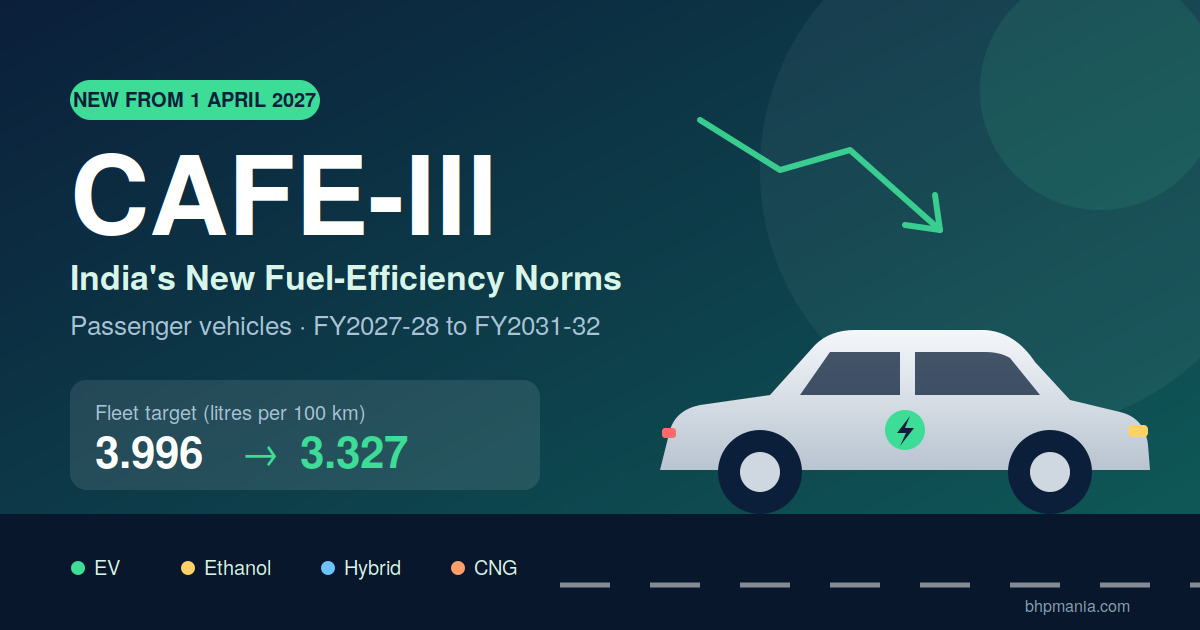
Bengaluru, India, September 30, 2026: The Government of India has notified the third phase of Corporate Average Fuel Economy (CAFE-III) norms for passenger vehicles, introducing a new five-year fuel-efficiency and emissions framework that will come into effect from April 1, 2027.
Notified by the Ministry of Power on September 29, 2026, the CAFE-III norms will apply until March 31, 2032, and cover M1 category passenger vehicles manufactured or imported for sale in India. The framework is aimed at progressively improving fleet-average fuel efficiency while providing automakers with multiple routes to meet their targets.
“We congratulate the Government of India for bringing out a progressive and forward-looking CAFE 3 regulation that reflects the nation’s aspiration to advance sustainable mobility,” said Vikram Gulati, Country Head & Executive VP, Toyota Kirloskar Motor.
“The CAFE 3 regulation takes due cognisance of the importance of various clean technologies using an objective and scientific based assessment methodology to arrive at a regulation that is best suited for our national interests. Therefore, Aligning to multi pathway approach ,battery electric vehicles (BEVs), Range Extenders (REEV), Plug-in Hybrid Vehicles (PHEVs), Strong Hybrid Electric Vehicles (SHEVs) and Flex Fuel Vehicles (FFVs), including Flex Fuel Strong Hybrid Vehicles (FFV-SHEV) have all been fairly recognised. This will enable the country to rapidly reduce its dependence on imported fossil fuels by leveraging the benefits of high levels of energy efficiency provided by Hybrid vehicles and substituting fossil fuels with electricity using BEVs/PHEVs/REEVs as well as with indigenous and green biofuels like ethanol, that also provide higher income opportunities to our farmers, by using FFV & FFV-SHEV.
“We would also like to thank the Government for following a deep & transparent consultation process with all stakeholders in formulating this regulation that allowed all points of view to be objectively evaluated and incorporated in the final regulation.
“This regulation is a big step forward and will play an important role in India’s march towards realising its goal of energy independence by 2047 as well as carbon net-neutral by 2070,” he added.
Shailesh Chandra, MD & CEO, Tata Motors Passenger Vehicles Ltd., said: “The CAFE III framework is an important step in advancing India’s journey towards cleaner and more sustainable mobility. We welcome the Government’s consultative approach in developing a framework that combines ambitious fuel efficiency targets with market-based compliance mechanisms. Importantly, the continued recognition of zero-emission technologies reinforces the critical role of electrification in achieving India’s long-term decarbonisation objectives. The clarity and predictability provided by the framework will enable the industry to plan investments, accelerate innovation and offer customers an increasingly compelling range of cleaner mobility solutions. At Tata Motors, we remain committed to leading this transition through sustained investments in electric mobility and other technologies that can meaningfully reduce emissions.”
Tarun Garg, MD & CEO, Hyundai Motor India Limited, said: “The final notification of the CAFE-III norms is a positive stesp by the Government towards advancing sustainable mobility in India and provides a clear long-term raomplying with all applicable regulatory norms and meeting both current and future CAFE requirements. The 3+2-year compliance block structure provides greater regulatory predictability and enables automakers to undertake long-term product and technology planning with greater certainty.
Rajat Mahajan, Partner and Auto Sector Leader, Deloitte India: said: “The CAFE 3 norms prioritise the role of transportation in tacking air pollution, and give the industry a clear direction for the next five years. The targets get tighter every year, more so for the heavy vehicles under the final draft version, but manufacturers can reap benefits by transitioning to electric, hybrid, alternative-fuel and fuel-saving technologies. Adhering the norms will require careful product planning and substantial investment in new age technologies. These norms are going to accelerate India’s NEV transition. OEMs who may not be able to switch their larger portfolio fast enough, may end up trading credits within the 2 compliance blocks to avoid penalties.”
CAFE-III Targets Become Progressively Stricter
Under the new regulations, the annual average fuel-consumption standard for manufacturers will become progressively tighter during the five-year period.
The benchmark moves from 3.996 litres per 100 km in FY2027-28 to 3.3273 litres per 100 km in FY2031-32, representing an improvement of approximately 16.7% over the period. In CO₂ terms, the corresponding benchmark falls from around 94.76g/km to 78.90g/km.
Unlike a system that assesses individual models in isolation, CAFE regulations measure the average performance of an automaker’s eligible passenger-vehicle fleet. The target is linked to the weighted average unladen mass of the vehicles sold by each manufacturer.
The final notification also raises the reference weight used in the target formula to 1,229kg, compared with 1,082kg under the earlier framework. The revised target curve gives relatively more headroom to lighter vehicles while requiring greater efficiency improvements from heavier vehicles.
No Separate Small-Car Concession
One of the significant changes from the earlier draft is the removal of a proposed 3g/km concession for petrol cars weighing below 909kg.
Instead, the government has modified the underlying weight-based target curve. The Ministry of Power has described the final framework as technology-neutral and designed to provide flexibility to manufacturers while progressively tightening fuel-efficiency requirements.
The change will be closely watched by manufacturers with large portfolios of entry-level and small cars, as the final rules do not provide the separate small-car benefit that had featured in the draft proposal.
EVs Get 3X Super Credit
Electric vehicles receive the biggest compliance benefit under CAFE-III.
Battery electric vehicles (BEVs) and range-extended electric vehicles (REEVs) receive a 3X volume derogation factor, effectively giving them greater weight when a manufacturer’s fleet-average performance is calculated.
Plug-in hybrid electric vehicles, strong hybrid electric vehicles and certain flex-fuel vehicles also receive super-credit benefits, although at different levels. Strong hybrids, for example, receive a 1.6X factor, while the framework provides higher factors for certain plug-in and flex-fuel hybrid configurations.
The system is designed to encourage manufacturers to introduce and sell more efficient and electrified vehicles as part of their overall portfolios.
Hybrids, Ethanol and CNG Also Get Benefits
CAFE-III does not focus exclusively on battery-electric vehicles. The final framework provides compliance benefits for several alternative powertrain and fuel technologies.
The notification introduces Carbon Neutrality Factors (CNF) for petrol, CNG and flex-fuel ethanol vehicles. E20 and higher ethanol-blended petrol vehicles receive an 8% CNF, while flex-fuel ethanol vehicles receive a 22.3% CNF. CNG vehicles receive a 5% CNF or the applicable CBG blending percentage notified by the Ministry of Petroleum and Natural Gas, whichever is higher.
This gives manufacturers several technology pathways to improve their fleet-average CAFE performance rather than relying solely on battery-electric vehicles.
More Fuel-Saving Technologies Can Earn Credits
CAFE-III also expands the list of technologies that can qualify for fuel-consumption reductions.
Manufacturers can claim a 1g/km CO₂-equivalent reduction for each eligible technology, subject to an overall cap of 9g/km.
The recognised technologies include:
- Start-stop systems
- Tyre-pressure monitoring systems
- Regenerative braking
- Six-speed or higher transmissions
- Efficient 12V/48V alternators
- 12V/48V motor-generators or micro-hybrid systems
- Exterior LED lighting
- Advanced glazing
- Electric water pumps
- High-efficiency air-conditioning systems
- Solar-reflective paint
- PWM-controlled radiator fans
The certification methodology for these technologies will be developed by the Ministry of Road Transport and Highways.
Carmakers Can Trade CAFE Credits
Another important feature of CAFE-III is the introduction of a credit and debit mechanism.
Manufacturers that perform better than their prescribed targets can generate credits, while those falling short can use eligible credits, trade with other manufacturers or purchase credits through the Bureau of Energy Efficiency’s buyout mechanism.
The regulations divide compliance into two blocks, with the first covering three years from FY2027-28 and the second covering two years from FY2030-31.
The framework also introduces formal reporting requirements, with manufacturers required to report vehicle performance using both the Modified Indian Driving Cycle (MIDC) and Worldwide Harmonized Light Vehicles Test Procedure (WLTP).
Small-Volume Manufacturers Exempt
Manufacturers selling fewer than 1,000 vehicles annually will be exempt from the fleet-average target requirements, although they will still have reporting obligations.
The notification also specifies annual reporting and credit-trading timelines, with data submission by September 30, a trading window during October and final passbook submission by November 30.
What CAFE-III Means for India’s Car Industry
The new CAFE-III framework is likely to have a significant influence on product planning for Indian automakers from 2027 onwards.
Manufacturers will need to manage the efficiency of their entire passenger-vehicle portfolios, rather than looking at individual models alone. This could encourage greater use of EVs, hybrids, range-extender technology, efficient combustion engines and fuel-saving technologies.
The availability of super credits and credit trading also gives manufacturers flexibility in determining how they meet their fleet-average targets.
Industry bodies and automakers have welcomed the notification. SIAM President Shenu Agarwal said the framework provides a structured roadmap for the next five years, while representatives of Mahindra & Mahindra and Tata Motors also welcomed the clarity provided by the new regulations.
With CAFE-III coming into force on April 1, 2027, India’s passenger-vehicle industry now has a defined five-year roadmap for improving fleet fuel efficiency and reducing average carbon emissions.
Share this content:











Post Comment