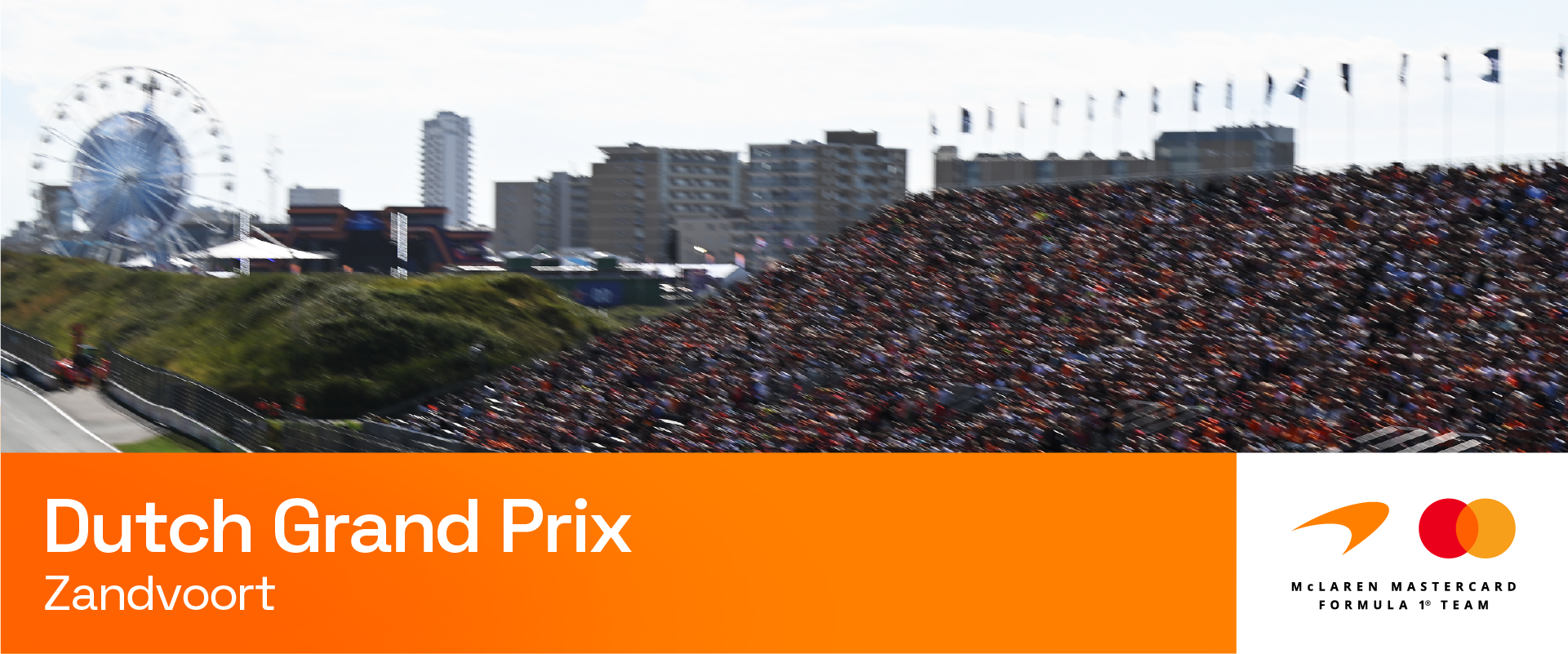
McLaren Targets Strong Start to Second Half of 2026 F1 Season at Dutch Grand Prix
Zandvoort, Netherlands, August 19, 2026: McLaren Mastercard Formula 1 Team returns to Formula 1 action this weekend at Circuit Zandvoort for the 2026 Dutch Grand Prix, as the team begins the second half of the season with renewed momentum following its breakthrough victory in Hungary.
The summer shutdown provided the McLaren team with an opportunity to recharge following an intense opening phase of the 2026 Formula 1 season. However, with the championship battle remaining highly competitive, McLaren is now focused on maximising performance, improving execution and continuing the development of the MCL40 across the remaining 12 races.
McLaren heads to the Netherlands encouraged by its performance at the Hungarian Grand Prix, where the MCL40 delivered the team’s first victory of the season at a demanding high-downforce circuit.
The team will now look to transfer those lessons to Zandvoort, which presents a significantly different challenge with its fast and flowing layout, banked corners, undulations and narrow margins for error.
McLaren brings further MCL40 upgrades to Zandvoort
McLaren will introduce further developments to its 2026 Formula 1 car at the Dutch Grand Prix as part of its ongoing development programme.
The latest upgrades focus on the rear of the MCL40 and are intended to complete the package introduced in Hungary. The new components include a new rear wing and new rear brake ducts.
The team’s priority will be to validate the upgrades as quickly as possible during the weekend, understand their contribution to overall performance and extract maximum benefit from them during qualifying and the race.
Technical Director, Applied Engineering Neil Houldey said the team was aware of the narrow performance gap at the front of the field and the importance of reliability and execution.
“We head into the Zandvoort weekend after finishing the final race before the shutdown with a win and a strong performance, but we are very aware of how close the competition is and how important reliability will be,” Houldey said.
He added that McLaren had learned more about how the MCL40 needs to be driven to extract performance while also addressing issues encountered earlier in the season.
Zandvoort presents unique engineering challenge
The 2026 Dutch Grand Prix will provide McLaren with a different engineering challenge compared with the Hungaroring.
Zandvoort’s banked corners, high-speed sections, undulating track and frequently changing wind conditions can make car balance particularly difficult to manage.
Houldey said one of the team’s key objectives would be finding the correct compromise between stiffness and ride performance over the circuit’s bumpier sections, while also optimising aerodynamic settings and ride heights during practice.
The characteristics of the 2026 Formula 1 cars will add another dimension to the challenge. Reduced downforce is expected to result in lower cornering speeds, while increased power and reduced drag in straight-line running should produce higher speeds on the straights.
As a result, practice sessions will be particularly important for McLaren as it evaluates the new upgrades, fine-tunes energy harvesting and deployment and adapts its setup to changing weather conditions.
“Overall, we look forward to getting back racing after the break. We are moving into an extremely demanding second half of the season and with 12 races still to come, the team’s attention remains firmly on our own development and performance,” Houldey said.
McLaren’s strong Dutch Grand Prix record
McLaren has enjoyed considerable success at the Dutch Grand Prix, recording five victories, three pole positions, nine podium finishes and three fastest laps at Zandvoort.
The team’s most recent victory came in 2025, when Oscar Piastri won the Dutch Grand Prix driving the McLaren MCL39.
McLaren’s historic record at Zandvoort also includes Niki Lauda’s victory in 1985, which was the Austrian’s final Formula 1 win.
The team also looks back fondly on the 2024 Dutch Grand Prix, when Lando Norris defeated Max Verstappen to claim victory in the MCL38.
Norris started that race from pole position and initially lost the lead to Verstappen into Tarzan corner. However, McLaren’s race pace and tyre management eventually allowed Norris to regain the advantage.
On Lap 18, Norris completed a clean pass on Verstappen at Tarzan before pulling away from the Red Bull. He eventually crossed the finish line 23 seconds ahead of Verstappen, securing his second Formula 1 victory and the fastest lap.
That result proved particularly significant in McLaren’s 2024 championship campaign, helping the team close the gap to Red Bull in the Constructors’ Championship during a crucial phase of the season.
McLaren drivers in action across multiple championships
McLaren’s wider racing programme will also be active this weekend.
Pato O’Ward, Christian Lundgaard and Nolan Siegel will represent the Arrow McLaren IndyCar Team in the Freedom 250 Grand Prix on the streets of Washington D.C.
Meanwhile, McLaren Driver Development Programme members Ella Lloyd and Ella Stevens will compete in F1 Academy at Zandvoort.
Richard Verschoor and Grégoire Saucy are scheduled to race in the European Le Mans Series at Circuit de Spa-Francorchamps, while Dries Van Langendonck will compete at Donington Park in British F4.
With the 2026 Formula 1 championship entering its decisive second half, McLaren will be looking to convert its Hungarian breakthrough into sustained performance. The Dutch Grand Prix will provide the first opportunity to see whether the latest MCL40 developments can further close the gap to its rivals and strengthen the team’s position in the championship battle.
Share this content:





Post Comment