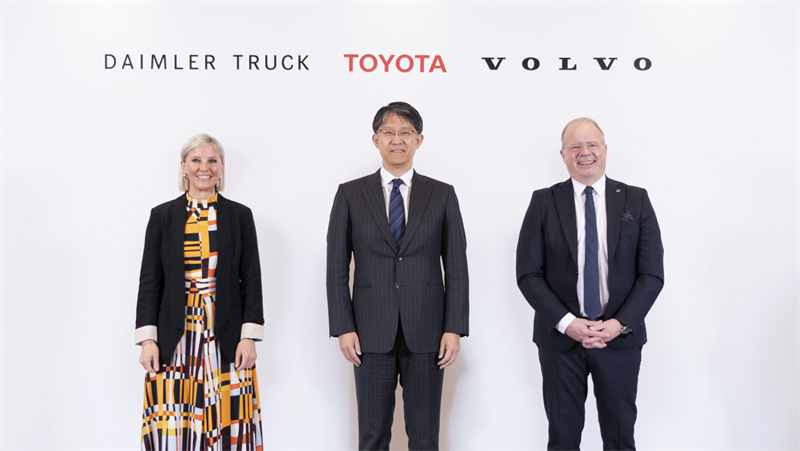
Volvo Group, Daimler Truck and Toyota partner to accelerate hydrogen fuel cell systems via cellcentric JV
Global, March 31, 2026 — In a major push toward zero-emission transport, Volvo Group, Daimler Truck AG, and Toyota Motor Corporation have signed a non-binding agreement to jointly collaborate in the fuel cell joint venture cellcentric. The move aims to accelerate the development, production, and commercialisation of hydrogen fuel cell systems for heavy-duty transport and industrial applications.
Under the proposed structure, Toyota is expected to join cellcentric as an equal shareholder alongside Volvo Group and Daimler Truck, creating a three-way partnership that combines deep expertise in commercial vehicles and advanced fuel cell technology.
Strategic collaboration to scale hydrogen mobility
The collaboration brings together Volvo’s and Daimler Truck’s commercial vehicle leadership with Toyota’s decades-long experience in fuel cell development and manufacturing. Together, the companies aim to strengthen cellcentric’s position as a global centre of competence for hydrogen fuel cell systems.
The partnership will focus on:
- Developing and producing fuel cell systems for heavy-duty on-road and off-road vehicles
- Expanding into stationary and industrial applications
- Scaling manufacturing and commercial deployment
Additionally, Toyota and cellcentric plan to jointly advance the development and production of fuel cell unit cells—the core components of hydrogen systems—along with related architecture and control technologies.
Hydrogen positioned as key to decarbonising transport
The three companies have identified hydrogen as a critical energy source in achieving net-zero transportation, particularly for heavy-duty applications where battery-electric solutions may face limitations.
By leveraging this partnership, the companies aim to:
- Accelerate technological innovation in fuel cells
- Improve cost efficiency through scale
- Support the development of hydrogen infrastructure globally
The collaboration also aligns with broader sustainability initiatives, including Europe’s green transition goals and Japan’s long-term vision for a hydrogen-based society.
Leadership views: “A big leap toward decarbonisation”
Executives from all three companies highlighted the importance of collaboration in driving the hydrogen ecosystem forward.
Martin Lundstedt, President and CEO of Volvo Group, said the partnership would help “accelerate and create critical mass for hydrogen applications,” adding that bringing Toyota onboard marks a significant step toward net-zero transportation.
Karin Rådström, President and CEO of Daimler Truck, emphasized that hydrogen technology will play a complementary role alongside battery-electric solutions in decarbonising transport.
Koji Sato, President and CEO of Toyota, noted that combining Toyota’s 30 years of fuel cell expertise with cellcentric’s commercial vehicle focus could deliver world-leading fuel cell systems for heavy-duty vehicles.
Meanwhile, Nicholas Loughlan described Toyota’s planned entry as a strong vote of confidence that will help strengthen the company across the entire value chain.
Independent structure with shared ambition
Under the proposed agreement, cellcentric will continue to operate as an independent and autonomous entity, serving a wide range of customers across transport and industrial sectors. While the three companies will collaborate within the joint venture, they will remain competitors in other areas of their respective businesses.
The partnership is designed to:
- Combine complementary strengths
- Achieve scale and investment efficiency
- Accelerate market readiness of hydrogen fuel cell systems
Next steps
The agreement remains non-binding, with all parties set to continue discussions toward a definitive deal. Any final agreement will be subject to regulatory approvals and internal board clearances.
If formalised, the collaboration is expected to play a pivotal role in advancing hydrogen as a mainstream solution for heavy-duty mobility, reinforcing the global shift toward sustainable and zero-emission transport systems.
Share this content:









Post Comment