India EV Retail Sales Surge 49% YoY in February 2026; Electric Two-Wheelers and Three-Wheelers Lead Growth
India’s electric vehicle (EV) market continued its strong growth momentum in February 2026, with retail sales showing robust year-on-year expansion across most segments, according to data released by Federation of Automobile Dealers Associations (FADA). While monthly sales moderated slightly compared with January 2026, overall EV adoption remains on a strong upward trajectory driven by rising consumer acceptance, expanding product portfolios, and government policy support.
The data, collated in collaboration with the Ministry of Road Transport and Highways (MoRTH), indicates significant growth in electric two-wheelers, passenger vehicles, and commercial vehicles, with electric three-wheelers continuing to dominate EV market share in India.
Electric Two-Wheeler Sales Continue Strong Growth
Electric two-wheelers remained the largest EV segment by volume in February 2026, with total retail sales reaching 111,709 units, representing 45.60% year-on-year growth compared with 76,722 units in February 2025.
However, the segment saw a 9.04% month-on-month decline from January 2026, when 122,812 units were sold.
Among manufacturers, TVS Motor Company led the segment with 31,614 units, posting 66.78% YoY growth, followed by Bajaj Auto with 25,328 units and Ather Energy at 20,584 units, both reporting healthy year-on-year increases.
Hero MotoCorp recorded a notable jump to 12,514 units, reflecting a massive 364.17% YoY growth, highlighting its rapid expansion in the electric scooter space.
Other notable players included Greaves Electric Mobility, Ola Electric, and River Mobility, although some manufacturers reported month-on-month declines.
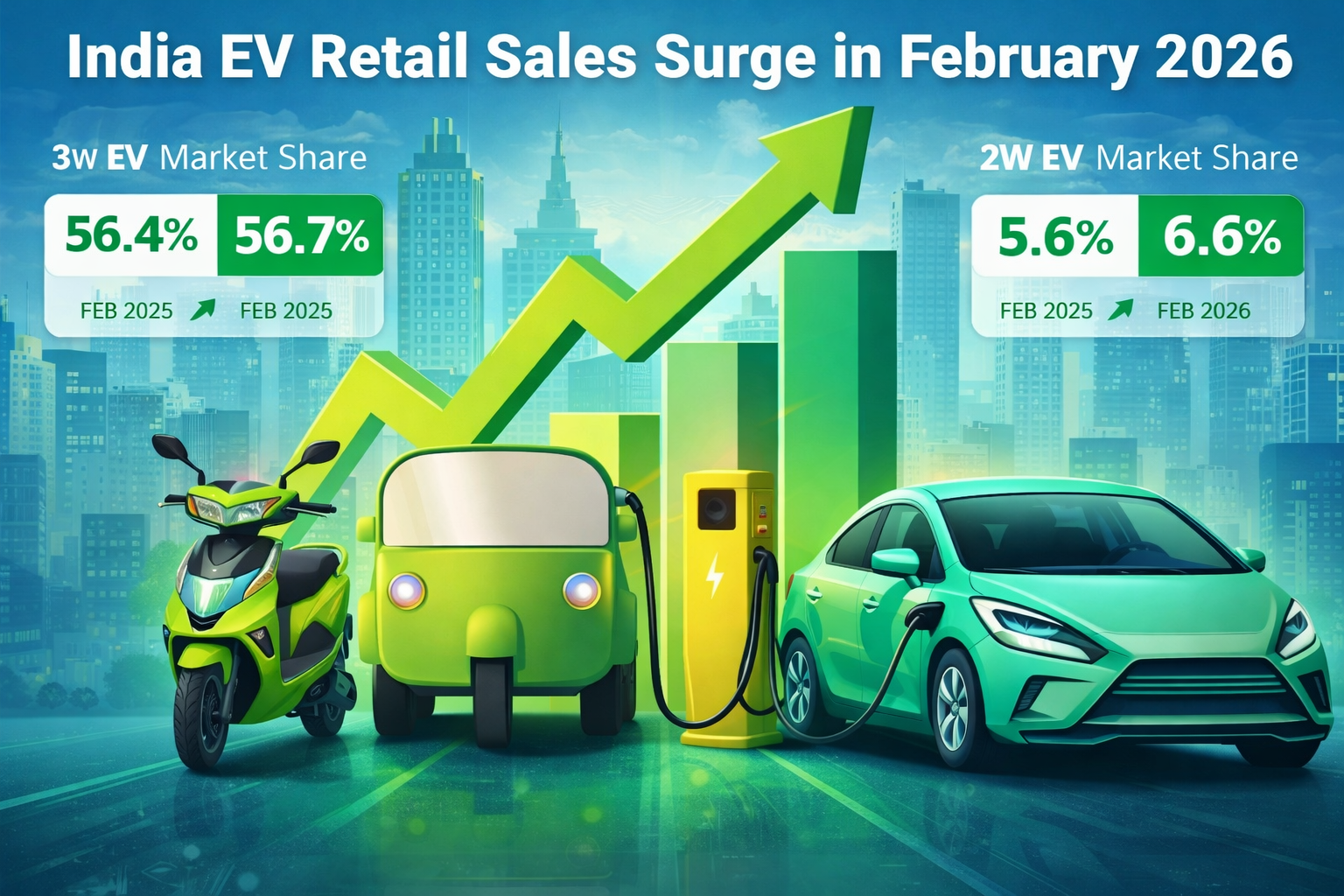
Overall, the EV penetration in the two-wheeler market stood at 6.6% in February 2026, unchanged from January but higher than 5.6% in February 2025.
Electric Three-Wheelers Maintain Market Leadership
Electric three-wheelers continue to be the largest EV segment by market share in India, accounting for 56.7% of total three-wheeler sales in February 2026.
Total retail sales in the segment stood at 66,398 units, reflecting 25.09% year-on-year growth, although volumes declined 12.37% month-on-month from January 2026.
Bajaj Auto retained the top position with 8,728 units, registering a 90.24% YoY increase.
The Mahindra Group, including Mahindra Last Mile Mobility, followed closely with 7,878 units, continuing to strengthen its presence in the electric three-wheeler cargo and passenger transport segments.
Other key contributors included TVS Motor Company, YC Electric Vehicle, and Piaggio Vehicles.
The continued dominance of electric three-wheelers is largely driven by commercial and last-mile mobility demand, particularly in urban and semi-urban markets.
Electric Passenger Vehicles See Rapid Expansion
India’s electric passenger vehicle segment also posted impressive gains, with retail sales reaching 13,733 units in February 2026, a 44.48% increase compared with February 2025.
However, the segment experienced a 25.65% month-on-month decline from January 2026’s 18,470 units.
Tata Motors remained the market leader with 5,568 units, representing 38.51% YoY growth.
MG Motor India followed with 3,312 units, while Mahindra & Mahindra recorded 2,913 units, posting an impressive 473.43% YoY growth, highlighting the strong demand for its expanding EV portfolio.
Other automakers in the segment included BYD India, Hyundai Motor India, Kia India, BMW India, Mercedes‑Benz, and Tesla India Motors and Energy, reflecting increasing competition across mass and premium EV segments.
Electric vehicles accounted for 3.5% of passenger vehicle sales in February 2026, slightly lower than 3.6% in January, but higher than 3.0% in February 2025.
Electric Commercial Vehicles Post Triple-Digit Growth
Electric commercial vehicles (CVs) saw the highest year-on-year growth rate, with retail sales surging to 2,051 units in February 2026, up 156.4% compared with 800 units in February 2025.
Month-on-month volumes remained largely stable, declining marginally by 0.44%.
Tata Motors led the segment with 638 units, followed by Switch Mobility with 358 units and Euler Motors with 293 units.
Other key contributors included Mahindra Group, JBM Auto, and PMI Electro Mobility Solutions, indicating rising adoption of electric buses and cargo vehicles in logistics and public transport.
The EV penetration in the commercial vehicle segment reached 2.03% in February 2026, up from 1.02% in February 2025.
EV Market Outlook
Industry experts believe the Indian EV market will continue to expand rapidly as charging infrastructure improves, battery costs decline, and automakers introduce new electric models across segments.
Electric three-wheelers and two-wheelers are expected to remain the primary drivers of EV adoption due to their lower cost and strong suitability for urban mobility and last-mile logistics.
With increasing participation from both domestic manufacturers and global brands, India’s EV ecosystem is gradually evolving into one of the world’s fastest-growing electric mobility markets.
Share this content:








Post Comment