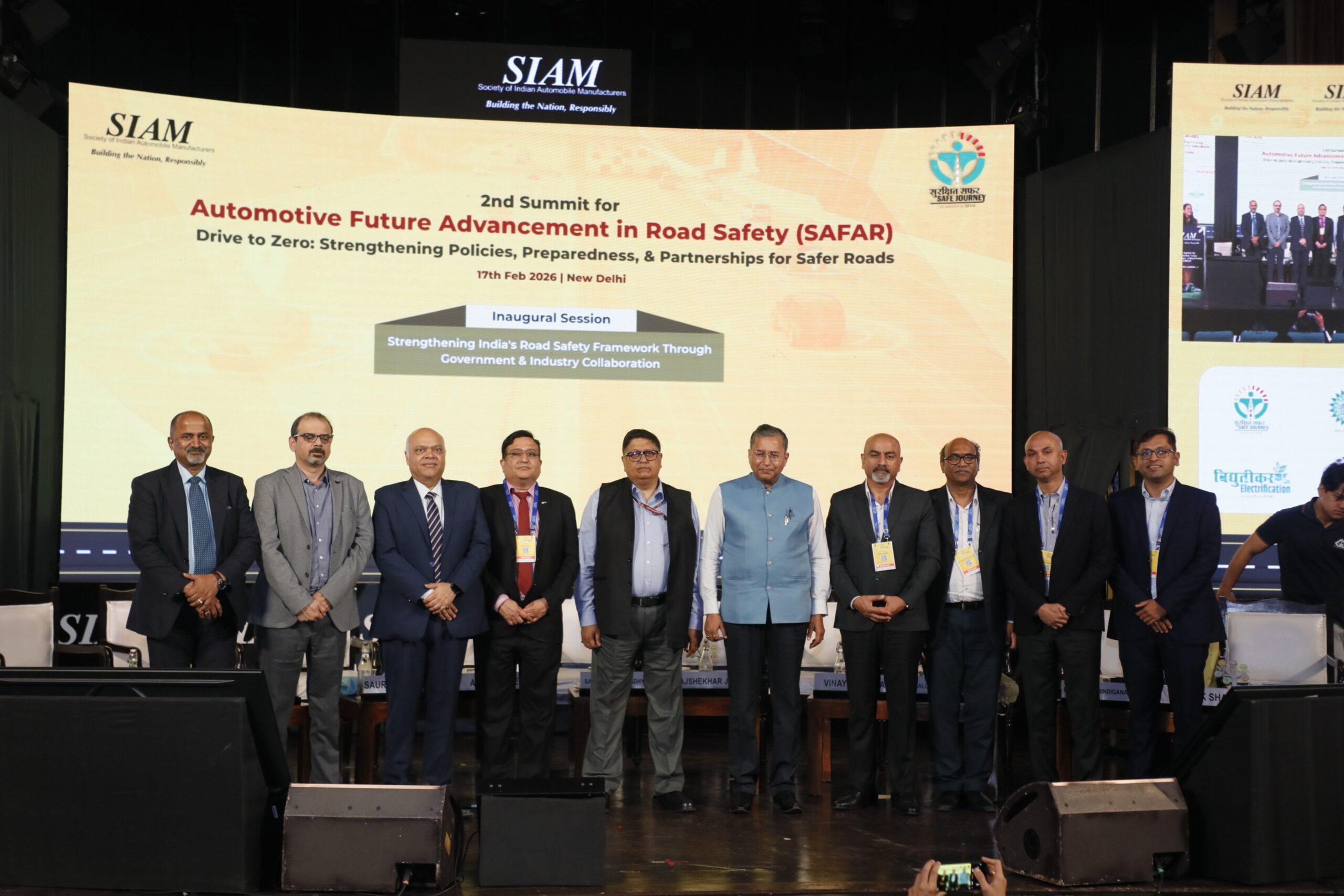
SIAM Hosts 2nd SAFAR Summit 2026, Calls for ‘Drive to Zero’ to Reduce Road Fatalities in India
New Delhi, February 17, 2026: In a renewed push to curb rising road accidents in India, the Society of Indian Automobile Manufacturers (SIAM) hosted the 2nd Summit on Automotive Future Advancement in Road Safety (SAFAR) under the theme ‘Drive to Zero: Strengthening Policies, Preparedness, and Partnerships’. The summit forms a key highlight of SIAM Sustainable Mobility Week 2026, being held from February 16 to 19 in the national capital.
The four-day initiative serves as a collaborative platform bringing together policymakers, industry leaders, emergency care experts, Original Equipment Manufacturers (OEMs), Non-Governmental Organisations (NGOs), and civil society stakeholders to deliberate on decarbonisation, road safety, post-crash response, circularity, material compliance, and cross-sector partnerships.
Focus on Zero Fatalities and Stronger Road Safety Framework
The inaugural session, titled “Strengthening India’s Road Safety Framework Through Government & Industry Collaboration,” underscored the urgent need for policy reform, better preparedness, and institutional accountability.
Chief Guest Dr. Rajshekhar Joshi, Vice Chairman of Sethu Aayog, Uttarakhand, stressed the need for a mission-oriented approach to road safety education. He highlighted the role of artificial intelligence (AI) in identifying accident black spots and strengthening emergency response systems, along with leveraging social media for awareness campaigns.
Guest of Honour Sanjay Bandopadhyaya, Member of the Supreme Court Committee on Road Safety, emphasized enforcement and accountability. He pointed to the Government of India’s zero-fatality programme across 100 districts and the importance of coordination among police, health, transport, and insurance authorities, supported by AI-based safety integration.
Welcoming the dignitaries, Prashant K Banerjee, Executive Director, SIAM, noted that India’s position as the world’s third-largest automobile industry brings a heightened responsibility toward road safety. He called for greater youth engagement and collective efforts under initiatives such as ‘Surakshit Safar’ to strengthen ‘Sadak Suraksha’ and ‘Jeevan Raksha’.
Industry Leaders Highlight Gaps and Technology Solutions
Alok Jaitley, President SAFE and Executive Vice President at Maruti Suzuki India Ltd., said India records nearly 4.8 lakh road accidents annually, reflecting systemic gaps. He emphasized shared responsibility backed by stronger policy, improved road behaviour, faster response mechanisms, and effective use of technology.
Vinay Dhingra, Senior Director at Honda Motorcycle and Scooter India Pvt. Ltd., underlined that road safety is central to the vision of Viksit Bharat. He pointed to persistent behavioural issues such as non-usage of helmets and seat belts and advocated for technology-driven licensing systems.
Chalumuri Ravi Shekhar, Director, CRRI, discussed AI-powered initiatives like iRASTE in Telangana aimed at reducing crashes and fatalities by 50 percent through integrated infrastructure safety and mobility analysis. He highlighted technologies such as Advanced Driver Assistance Systems (ADAS) and Driver Monitoring Systems.
Dr. Manish Jaiswal, Director, NATREX, said 10–12 percent of accidents are linked to road infrastructure issues, calling for stronger policies on crash-barrier testing and next-generation highway frameworks. Saurabh Dalela, Director, ICAT, added that rear seat-belt usage remains low, while nearly 70 percent of road accidents involve two-wheelers, reinforcing the need for stronger SOPs and institutional coordination.
Sustainable Mobility Zone Showcases Next-Gen Safety Tech
Running alongside the conference, SIAM’s Sustainable Mobility Zone emerged as a major attraction, showcasing next-generation vehicle platforms, advanced safety systems, alternative fuel technologies, and enabling infrastructure solutions. The live demonstrations offered participants real-world insights into cleaner, safer, and more efficient mobility innovations.
The summit also witnessed the launch of a Context Paper titled “Advancing Road Safety Through Systemic Policy Reform,” aimed at strengthening India’s policy architecture for road safety.
Technical Sessions and Post-Crash Response Workshop
The Technical Session on “Innovation in Vehicular Safety Technology,” moderated by Deepanshu Taumar, Editor, ET Auto, featured insights from experts across connected safety chains, digital radio innovations, ADAS advancements, vision-based safety technologies, and driver assistance systems.
A dedicated workshop on “Saving Lives Post Crashes” focused on trauma response and life-saving skills. Captain Sandhya Shanker Pandey of Fortis Healthcare highlighted how trauma teams are often forced into damage control due to delayed intervention, underscoring the importance of timely post-crash care.
The final panel discussion, moderated by Sumit Chaturvedi, Founder and Editor-in-Chief of VoiWorld.com, centered on shared education, data collaboration, and community-focused vehicle technologies. Panelists represented leading organisations including Hero MotoCorp Ltd. and Asian Road Safety Academy, among others.
SIAM Sustainable Mobility Week 2026 Continues
As part of the broader Sustainable Mobility Week, SIAM will host the 4th International Conference on Sustainable Circularity (ICSC) on February 18, followed by the 1st International Conference on Automotive Material Compliance & Sustainability (AMCS) on February 19, further advancing discussions on responsible manufacturing and future-ready mobility solutions.
Over the years, SIAM has worked closely with governments and industry stakeholders to accelerate the transition toward cleaner fuels, advanced technologies, and safer mobility ecosystems. Through initiatives aligned with its vision of ‘Building the Nation Responsibly,’ SIAM continues to contribute meaningfully toward India’s Sustainable Development Goals for 2030.
Share this content:








Post Comment